This Week in the Unmanned Systems and Robotics World
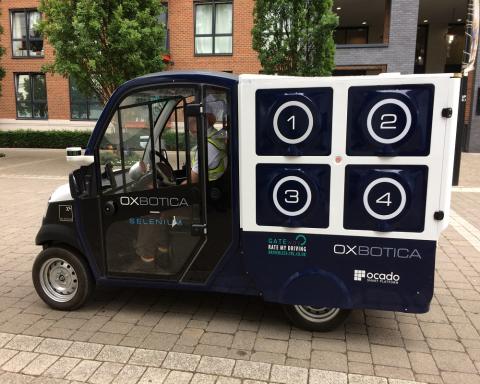
An Oxbotica-developed autonomous vehicle called CargoPod is being used in London to deliver groceries to customers. The vehicle has eight pods on the back of it, and each pod has a crate that can hold three bags of groceries. After the vehicle is filled by human hands from a small distribution center, it sets off following a route to its drop-offs. Once the CargoPod arrives at its destination, the customer is alerted through a smartphone. That customer must then press a button on the vehicle to open the pod door, allowing them to collect their groceries. (MIT Technology Review)
Robotics
Robotics
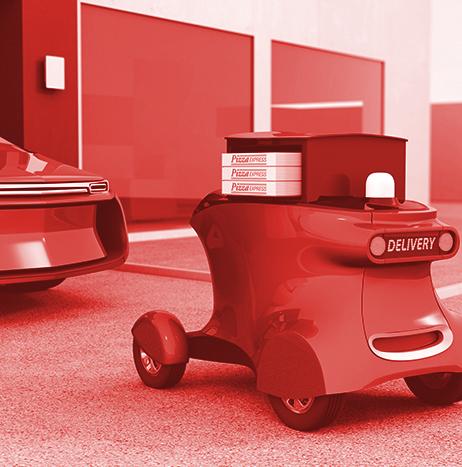
Virginia preparing to welcome autonomous delivery robots
With approval from local city councils, autonomous delivery robots will be legal in Virginia starting on July 1, after Virginia Gov. Terry McAuliffe signed legislation that will allow the robots to roam sidewalks to deliver things such as groceries, lunch or medicine to the doors of customers.
With the passing of this law, Virginia becomes the first state to pass a law that allows “personal delivery devices” on sidewalks and crosswalks.
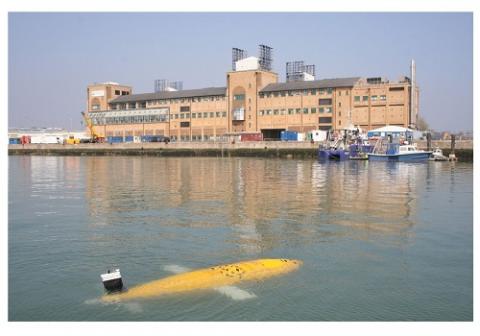
Boaty McBoatface AUV Set to Embark on Its First Research Mission
An autonomous underwater vehicle (AUV) named Boaty McBoatface is preparing to embark on its first research mission to Antarctica on March 17.
Boaty McBoatface will travel on the British Antarctic Survey (BAS) research ship, the James Clark Ross, as a part of the DynOPO (Dynamics of the Orkney Passage Outflow) expedition. The ship will depart from Punta Arenas in Chile.
During its mission, the AUV will be tasked with researching water flow and turbulence in the depths of the Orkney Passage, which is a 3.5km deep region of the Southern Ocean, and is known for having some of the coldest and deepest abyssal ocean waters on earth, which are known as Antarctic Bottom Water (AABW).
OTSAW Digital releases security robot equipped with its own drone
A startup company in Singapore called OTSAW Digital has released its four-wheeled security robot, named O-R3, which includes a drone that can be launched after intruders.
Because of its “drone-in-robot design,” the O-R3's range can extend significantly in comparison to the typical ground-based autonomous robot, giving the O-R3 capabilities that ordinary security robots wouldn’t have.
“[If] you have obstacles on the ground, we can launch a drone that has an aerial view of where the intruder is hiding, maybe on the other side of the wall, on the fence, or the gate, stuff like that,” says Ling Ting Ming, CEO of OTSAW Digital and its parent company ActiV Technology, through an article with Mashable.

Unmanned delivery robots headed to the sidewalks of Florida
Unmanned delivery robots can now legally travel on sidewalks and in crosswalks in Florida, after Governor Rick Scott signed a new law that permits their operation in the state, as long as a human can take over operation of the robots remotely in the event that something goes wrong.
Florida joins Virginia, Idaho and Wisconsin, who all finalized similar legislation in their respective states earlier this year.
These state laws were passed with the support of Starship Technologies, a company that creates these types of robots, and has been testing them in in Redwood City, California and Washington, D.C. this year. Lobbyists for Starship worked on all of the state proposals.
SoftBank acquires robotics pioneer Boston Dynamics
Softbank, which is a Japanese multinational telecommunications and Internet corporation, has entered into a definitive agreement to acquire Boston Dynamics, a robotics pioneer, from Alphabet Inc.
According to SoftBank, the transaction “aligns with SoftBank's investments in paradigm-shifting technologies and its vision of catalyzing the next wave of smart robotics.”
“We at Boston Dynamics are excited to be part of SoftBank's bold vision and its position creating the next technology revolution, and we share SoftBank's belief that advances in technology should be for the benefit of humanity,” says Marc Raibert, CEO and founder of Boston Dynamics.
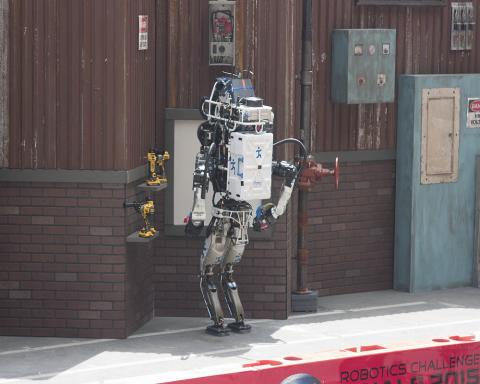
How Increasing Autonomy Will Create More Capable Ground Robots
The problem of achieving maximum autonomy has been a focus of the ground robotics community since the advent of unmanned technology. Robots capable of performing pre-determined tasks without human involvement are awakening new industries to the potential of ground robots.
Improved autonomy in recent years has allowed diverse industries to cut costs and improve efficiency by implementing these reliable vehicles. This webinar will feature a discussion of the approaching milestones in robot autonomy and what these capabilities mean for industries facing increased competition and shifting markets. Companies already utilizing ground robots will share their perspectives on how the technology has strengthened their businesses.
Who Should Attend
AUVSI XPONENTIAL 2018
This premier event unites the largest global community of drone, intelligent robotics and unmanned systems leaders to shape the future of the industry. Featuring the largest and most comprehensive trade show, this event is the spot to learn from daily keynotes with tech visionaries and 200+ world-class sessions as well as connect with 8,500+ industry pros and business experts from 20+ industries.
www.xponential.org
ACCEPTANCE, TRUST KEY FOR FUTURE OF GROUND ROBOT AUTONOMY
The iuture oí ground robot autonomy will h.nge largely on trust and accepiance, accordrnq lo a panel ihat spoke on Ihe lhird and rinal day 01AUVSI's Unmanned Systems Delense.