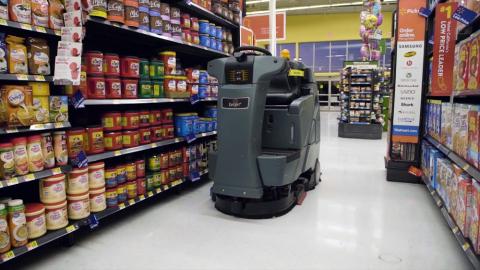
A San Diego-based software technology company called Brain Corp has announced that it will provide Walmart with artificial intelligence (AI) services, thanks to a new partnership with the world’s largest retailer.
Right now, Brain Corp’s Brain Operating System (BrainOS) platform automates more than a hundred of Walmart's fleet of commercial floor scrubbers across the U.S.
With BrainOS, the machines have autonomous navigation and data collection capabilities, which are all tied into a cloud-based reporting system.
By the end of its fiscal year, Jan. 31, 2019, Walmart expects to have 360 robots powered by BrainOS in its stores.
Robotics
Robotics
Universal Robots hires more than 20 Rethink Robotics staff members
Universal Robots (UR) has hired more than 20 Rethink Robotics staff members, merging its Boston office with Rethink’s former headquarters in Boston’s seaport area “with immediate effect.”
UR says that Rethink’s personnel brings “extensive” collaborative robotics experience in engineering, product development, and customer applications. This experience, combined with UR’s expertise, will help UR continue to develop new and innovative collaborative robotics platforms.

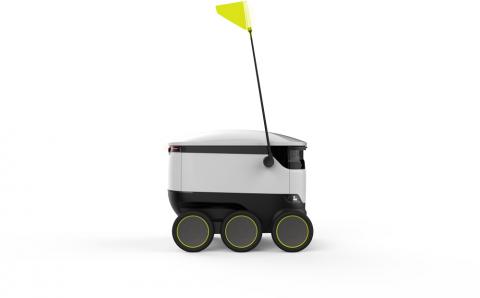
Starship Technologies' autonomous delivery robots take to the streets of the UK
On Oct. 31, Starship Technologies launched what it calls the world’s first autonomous package delivery service, as hundreds of the company’s robots will be used to deliver packages straight to the front doors of consumers.
Right now, the service is available through Starship’s official app for residents living in the UK (Milton Keynes). By simply clicking a button, these residents can have packages delivered to their front door whenever they choose.
According to Starship, once people sign up on the app, they will receive a ‘personal address’ in place of their home address or whichever location they normally get parcels delivered to. This personal address will be the location of a Starship managed local facility.
Textron Systems plans to acquire robotics developer Howe & Howe Technologies
Textron Systems is positioning itself as a global leader in autonomy across the air, land and sea domains, after entering into a letter of intent to purchase Howe & Howe Technologies Inc., a developer of advanced robotic land vehicles.
Built and proven for the most extreme conditions in the world, Howe & Howe’s vehicles have earned the trust of customers in the U.S, as U.S. government customers have selected Howe & Howe’s small, highly mobile Ripsaw Super Tank for its speed, mobility and off-road performance, while Howe & Howe’s RS2-H1 SMET was down-selected to compete to be the U.S. Army’s first platoon load-carrying robot, after completing a 60-mile test through swamp and jungle terrains.
Honeywell and Fetch Robotics collaborating to deliver autonomous mobile robots to distribution centers
Honeywell and Fetch Robotics are partnering to deliver autonomous mobile robots (AMRs) to distribution centers, in an effort to help them “more effectively fulfill growing volumes of e-commerce orders.”
The collaboration between the two entities enables Honeywell Intelligrated's customers to increase productivity and boost labor efficiency by deploying Fetch Robotics' AMRs, which transport items through distribution centers without human guidance or fixed paths, all while operating safely alongside people.
With Fetch Robotics’ AMRs a part of its smart robotics portfolio, Honeywell Intelligrated can provide customers with a range of flexible automation technology that can be adjusted to address current and future operational needs.
Airbus integrates Mobilicom's SkyHopper PRO technology into its Innovation drone platform
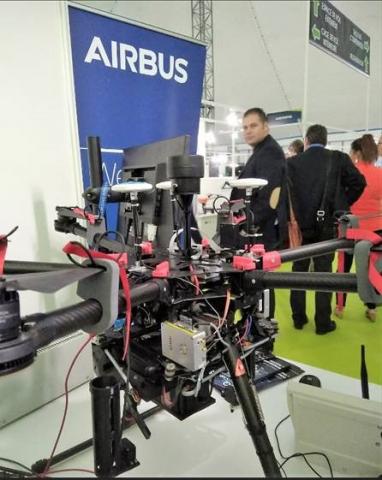
Airbus has integrated Mobilicom’s SkyHopper PRO technology into its Innovation drone platform, which is used to expand Airbus’ vision, and showcase the company’s mission operation technologies in the commercial and homeland security UAS space.
According to Mobilicom, SkyHopper is a “holistic solution” for commercial and industrial UAS and robotics. The SkyHopper PRO is a “communication solution” for control, telemetry and video or payload sharing to and from the UAS platform to the ground control systems and users.
Airbus is using the SkyHopper PRO Datalink with its mission specific software and accessories.
Forestay Capital acquires capital in Swiss navigation technology company BlueBotics
Forestay Capital Ltd has acquired capital in BlueBotics, a Swiss navigation technology company, to help facilitate international expansion. Forestay Capital is the Bertarelli closed-end tech fund that launched earlier this year.
Based in St-Sulpice, Switzerland, BlueBotics develops and sells navigation technologies for industrial vehicle automation. The company’s ANT product line has been installed in more than 1,000 vehicles across the world, as it addresses the needs of various industry verticals, including material handling, hospital logistics, and cleaning.
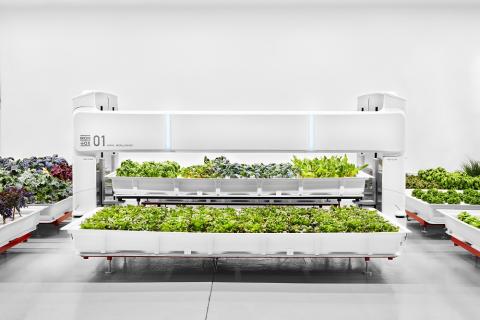
Iron Ox automates part of farming process with its robotic arms and movers
A startup robotics company called Iron Ox opened its first production facility in San Carlos, California on Oct. 3.
The company’s 8,000-square-foot indoor hydroponic facility is attached to its offices, and will produce leafy greens at a rate of roughly 26,000 heads a year, which is the production level of a typical outdoor farm that might be five times bigger, according to MIT Technology Review.
Iron Ox has 15 human employees that share their work space with robots that tend rows of leafy greens. Robotic arms individually pluck the plants from their hydroponic trays and transfer them to new trays as they increase in size, which maximizes their health and output. Robotic movers carry the 800-pound water-filled trays around the facility.
Carnegie Mellon University team to compete in DARPA robotics competition
A team from Carnegie Mellon University (CMU) will compete in the systems track of the Defense Advanced Research Projects Agency (DARPA) Subterranean Challenge.
A multi-year robotics competition with a $2 million prize, the Subterranean Challenge will task robots to autonomously search tunnels, caves and underground structures.
The Carnegie Mellon team, which includes a member from Oregon State University, is one of just six teams that will receive up to $4.5 million from DARPA to develop the robotic platforms, sensors and software needed to accomplish these “unprecedented underground missions.”
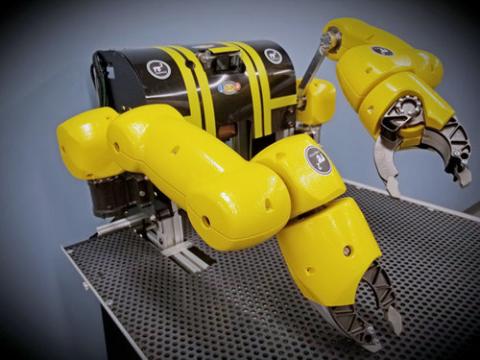
RE2 Robotics receives $2.5 million contract to continue developing its Dexterous Maritime Manipulation System
RE2 Robotics, which develops humanlike robotic manipulator arms, has received a $2.5 million contract from the Office of Naval Research to continue developing and commercializing its Dexterous Maritime Manipulation System (DM2S).
Equipped with RE2’s DM2S technology, Navy Explosive Ordnance Disposal (EOD) personnel will be able to “remotely and effectively” address Waterborne Improvised Explosive Devices (WBIEDs).
“As with the majority of our robotic technologies, the goal of the DM2S is to keep humans out of harm’s way while performing dangerous tasks,” says Jorgen Pedersen, president and CEO of RE2 Robotics.