
The Oil & Gas Technology Centre, Total E&P (Total), taurob and the Technische Universitaet Darmstadt (TU Darmstadt) are all working together to develop a robot that could work autonomously alongside humans on a North Sea platform.
Through an 18-month project, which is being described as a “world-first,” the entities will develop and trial a mobile robot for “autonomous operational inspection” of facilities on Total’s onshore Shetland Gas Plant and offshore Alwyn platform.
According to the entities, the trial is the first time that an autonomous ground robot will be used on an operational oil and gas installation, and they believe that the project “could start a revolution in robotics offshore that improves safety, enhances productivity and reduces costs.”
Robotics
Robotics
AI Incorporated releases design for autonomous refuse robot
AI Incorporated, which is a Canadian robotics and artificial intelligence research company, has released a design for an autonomous refuse robot, which is considered a new application for mobile robotics, the company says.
The new AI enhanced robotics system introduces a device that can autonomously travel to the curbside and wait for the pickup truck at pre-scheduled times. Scheduling is completed using an app, and a user can also use the app to control the robot in the event that it needs help with navigation, or if it gets stuck.
According to AI Incorporated, this invention will render humans emptying trash cans “a thing of the past,” as the bins will simply leave their post to be emptied when it is time for pickup.

DARPA soliciting proposals for second 'swarm sprint' for its OFFSET program focused on unmanned systems
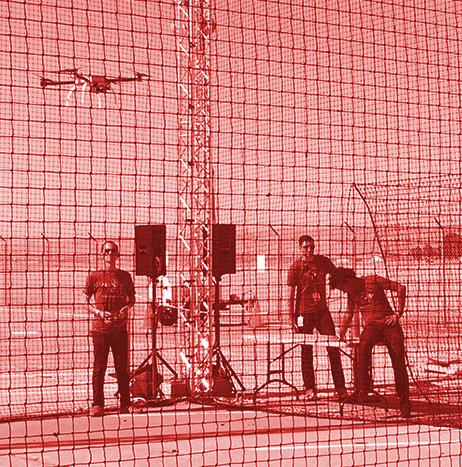
DARPA has announced that it is soliciting proposals for the second “swarm sprint” for its OFFensive Swarm-Enabled Tactics (OFFSET) program.
OFFSET envisions future small-unit infantry forces using small UAS and/or small unmanned ground systems (UGSs) in swarms of 250 robots or more to accomplish “diverse missions in complex urban environments.”
According to DARPA, each of the five core “sprints” focuses on one of the key thrust areas: Swarm Tactics, Swarm Autonomy, Human-Swarm Team, Virtual Environment, and Physical Testbed.
The second group of “Swarm Sprinters” will get the chance to work with one or both of the OFFSET Swarm Systems Integrator teams to develop and assess tactics, as well as algorithms, to enhance autonomy.
Weekend Roundup
This Week in the Unmanned Systems and Robotics World
From April 19 to 20, the UAS/Drones for Disaster Response conference will help key stakeholders that are responsible for responding to disasters better understand how UAS and other unmanned systems can enhance their efforts during missions. The conference will be held at the Biscayne Bay Campus of Florida International University. (PR Web)

WPI students building autonomous security robot for U.S. Air Force
A team of undergraduate students at Worcester Polytechnic Institute (WPI) in Worcester, Massachusetts is attempting to turn a wheelchair into an autonomous security robot that could help protect unmanned installations for the U.S. Air Force.
The students are building this proof-of-concept robot using a tracked all-terrain wheelchair (trackchair)— provided by a company called Action Trackchair Inc.—and about $8,000 for supplies.
According to WPI, the military wants to have robots at unmanned bases that can respond to and investigate intrusion alarms and other warnings within two minutes. The robots would be used to safeguard thousands of unmanned bases, such as missile silos, around the world.
Terabee's new TeraRanger Hub Evo provides 'lean sensing' for robotics
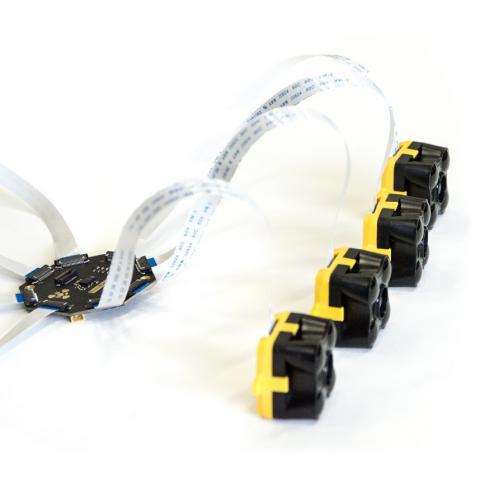
Terabee, which created the TeraRanger Time of Flight distance sensors, has announced the release of the TeraRanger Hub Evo, which the company describes as a new generation “plug and play solution for using multiple distance sensors.”
A “small, octagonal, PCB,” the TeraRanger Hub Evo allows users to connect up to eight TeraRanger Evo distance sensors and place them in whatever configuration they might need, so that they can monitor and gather data from just the areas and axes they need, and create custom point clouds, optimized to their application.
University of Hawai'i at Hilo offering certificate in UAS
The University of Hawaiʻi at Hilo (UH Hilo) has launched four new courses to establish a certificate in UAS, which is a first step in the university’s long-planned aeronautical science program.
UH Hilo students who complete the four courses, along with three upper-level geography classes in data interpretation, remote sensing and information systems, will receive a certificate in UAS.
“Unmanned aircraft are becoming more and more popular, with the potential being recognized by new industries every day,” says Arthur Cunningham, coordinator of the UH Hilo aeronautical science program.

From Unmanned Systems Magazine: Robots and Drones: Farm Workers of the Future?
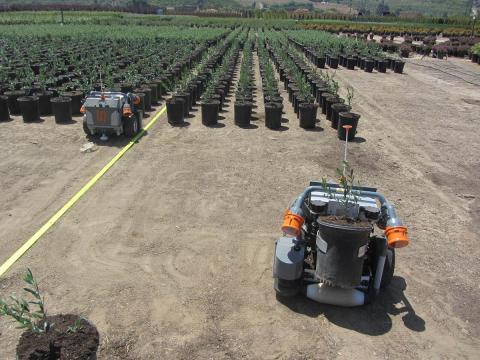
The agricultural industry is experiencing labor shortages in various parts of the United States today, and some growers and producers are turning to robots and drones to help keep their farms and greenhouses viable.
Wal-Mart deploying shelf-scanning robots in 50 of its stores
After testing shelf-scanning robots in stores in Arkansas, Pennsylvania and California, Wal-Mart has announced that approximately 50 of its stores across the United States will start using the robots to “replenish inventory faster,” in an effort to save employees time when products run out.
The two-foot tall robots, which are a product of a company called Bossa Nova Robotics, are equipped with cameras that scan aisles to check stock and identify items that are missing and misplaced, as well as incorrect prices and mislabeling. The data obtained by the robots is passed on to store employees, who then stock the shelves and correct errors.

University of Pennsylvania researchers to develop teams of robots for U.S. military
Thanks to a five-year, $27 million government grant from a United States Army Research Laboratory program that seeks to advance robotic technology, researchers from the University of Pennsylvania will develop a team of autonomous, specialized and resilient robots for the United States military.
One of the researchers for this project, Electrical and Systems Engineering Chair George Pappas, says that this research is unique because its focus will be on specialized teams of robots, instead of individual robots.
These robots will also be able to learn from one another in unknown environments.