
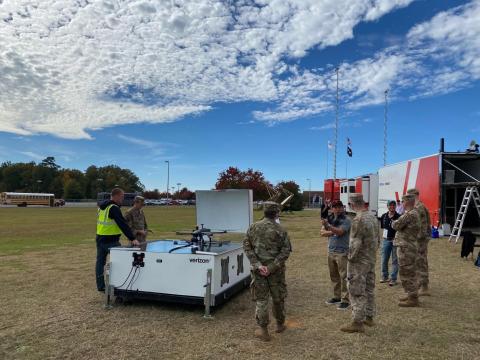
The United States Air Force Research Lab has awarded Asylon Inc. a contract to provide the future of persistent ISR, inspection and perimeter security.
According to Asylon, this includes the exploration of the ability to use available water-based resources in the mission operating environment to generate power and recharge air and ground autonomous platforms, which will allow them to operate longer at the point of need.
Under this contract, Asylon has partnered with Ghost Robotics. The companies will develop a combined, autonomous, and self-powering air and ground robotic platform by integrating their respective robotic systems. The platform will use DroneHome, which is Asylon’s patented automated battery SWAP base station.
Robotics
Robotics
Kraken Robotics, Greensea Systems partner to 'rapidly advance the capabilities of marine robotics'
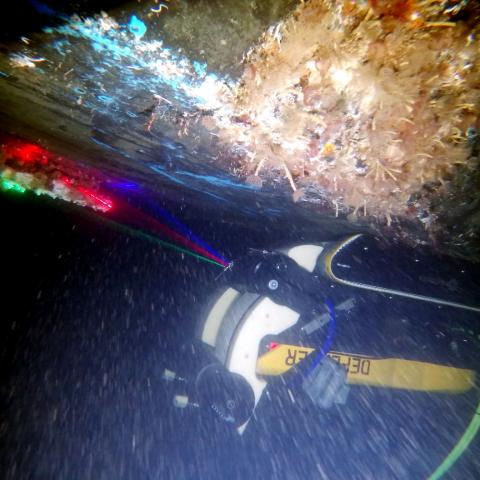
Kraken Robotics Inc. has entered into a partnership agreement with Greensea Systems Inc., which is known for its open architecture robotic platform called OPENSEA.
Under the agreement, Greensea will support development, integration, and testing work with Kraken across several of the company's technology platforms.
“The partnership we have signed is very significant. It is a relationship formed between the most disruptive, agile, and aggressive technology developers in the industry,” says Ben Kinnaman, CEO of Greensea.
RE2 Robotics fabricating face shields for small- and medium-sized clinics in Pittsburgh region
In collaboration with PPE Connect PGH and its coalition of local universities and manufacturers, RE2 Robotics has begun fabricating face shields for small- and medium-sized clinics.
PPE Connect PGH is helping healthcare workers on the front line in the fight against COVID-19 locate sources of existing idle Personal Protective Equipment (PPE).
Using its 3D-printing capabilities, RE2 is fabricating parts for face shields that are being collected and distributed by PPE Connect PGH. Smaller health care entities such as community clinics, nursing homes, and independent facilities in the Pittsburgh region can get the face shields and all of the PPE donations for free.

Stanford University researchers develop soft robot that can move and change shape
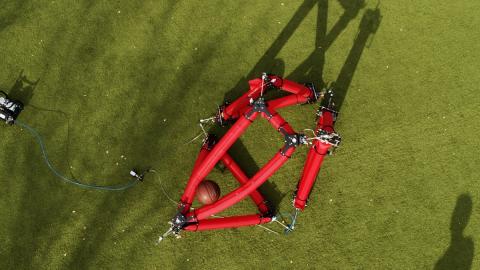
Stanford University researchers have developed a soft robot that borrows features from traditional robotics to stay safe while still retaining the ability to move and change shape.
“A significant limitation of most soft robots is that they have to be attached to a bulky air compressor or plugged into a wall, which prevents them from moving,” explains Nathan Usevitch, a graduate student in mechanical engineering at Stanford.
“So, we wondered: What if we kept the same amount of air within the robot all the time?”
Diligent Robotics announces $10 million series A investment
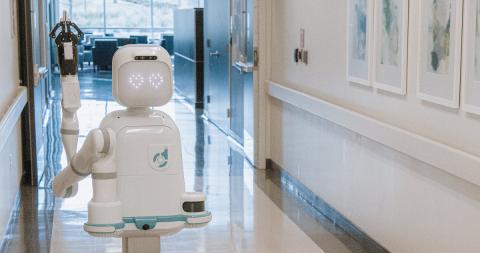
Artificial intelligence company Diligent Robotics has announced that it has raised a $10 million series A investment.
Known for its hospital robot assistant called Moxi, Diligent Robotics launched in 2017 and since its launch, it has worked alongside hundreds of nurses to understand their work, and ultimately help them redesign workflows to incorporate Moxi.
“Seeing the passion and humanity that nurses bring to their job has become the most inspiring part of our work. Every member of our team feels proud that we get to build something that makes a difference for nurses, because they are just amazing people,” Diligent Robotics says.
Autonomous Solutions, Phantom Auto help develop fully unmanned yard truck
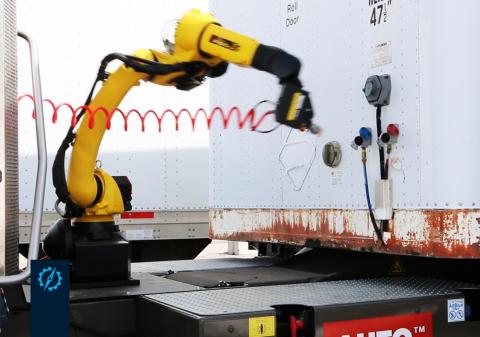
Autonomous Solutions Inc. (ASI), Phantom Auto, FANUC America Corporation, and Terberg have collaborated to develop a new fully unmanned yard truck platform.
“The combination of these four leading companies brings an autonomy solution that has never been more needed in the logistics sector to lower costs and increase safety and efficiency,” says Mel Torrie, founder and CEO of ASI.
With ASI’s Mobius software, operators have real-time awareness and control of a fleet of unmanned trucks. Both of these capabilities are driven by ASI’s autonomous vehicle technology.
DHL Supply Chain, Locus Robotics to deploy autonomous mobile robots to new locations
Through the expansion of their partnership, supply chain management and third-party logistics company DHL Supply Chain and autonomous mobile robots (AMR) developer Locus Robotics will launch 10 new, nationwide deployments of the Locus AMR platform this year.
“The agreement with Locus Robotics further enables us to bring productivity-enhancing technology to our customers quickly, so they are well-positioned to capitalize on new and emerging opportunities,” says Jim Gehr, president, Retail at DHL Supply Chain North America.
Kiwibots help University of Denver students learn how to build successful business
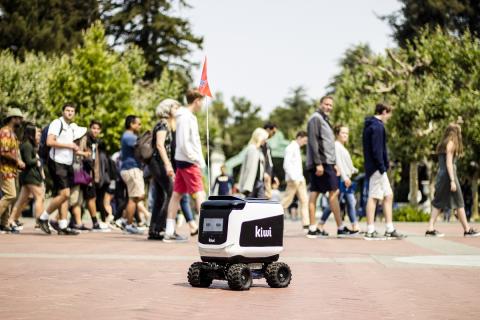
Delivery robots are popping up on college campuses across the United States, but the journey behind the Kiwibots currently operating on the campus of the University of Denver (DU) ironically enough did not begin on U.S. pavement.
Initially launched as a human-based food delivery company in Bogotá, Colombia, the first iteration of Kiwibot as a company was sold, which led to the team behind Kiwibot wanting to replicate its model where students could conduct deliveries for other students in the United States. The team found out, however, that the cost structure was not replicable from Latin America to the U.S., according to David Rodríguez, Kiwibot’s head of business.
“This was the point we decided we needed to start building robots,” Rodríguez tells AUVSI.
British Airways tests fully autonomous, electric mobility devices at New York's JFK Airport
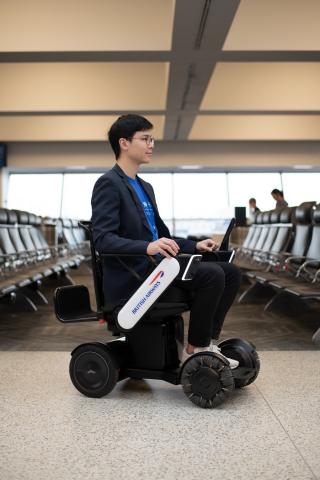
As part of its journey to become the airline of choice for customers with both hidden and visible disabilities, British Airways recently became the first airline to trial fully autonomous, electric mobility devices in North America.
Brain Corp, Dane Technologies partner to develop and test autonomous material delivery robots
Brain Corp is partnering with power assist technologies designer and manufacturer Dane Technologies to manufacture autonomous material delivery robots that can be used in public and commercial applications.
Dane Technologies will license Brain Corp’s cloud-connected operating system for commercial autonomous robots, BrainOS, and begin building the delivery robots in Q2 2020. Brain Corp and Dane Technologies plan to pilot the robots with several major retailers this spring.