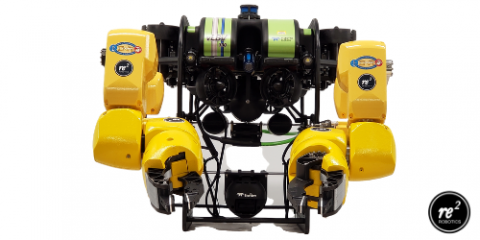
RE2 Robotics will continue the development and commercialization of its technology under the Dexterous Maritime Manipulation System (DM2S) program after receiving $2.5 million in funding from the Office of Naval Research.
Equipped with RE2’s DM2S technology, Navy personnel will be able to autonomously perform mine countermeasure (MCM) missions.
During the next phase of the program, RE2 Robotics will upgrade its dual-arm prototype, known as the Maritime Dexterous Manipulation System (MDMS), for deep ocean use. To enable autonomous manipulation capabilities, the company will also apply computer vision and machine-learning algorithms. Lastly, RE2 says that it will integrate with underwater vehicles that can autonomously navigate.
Robotics
Robotics
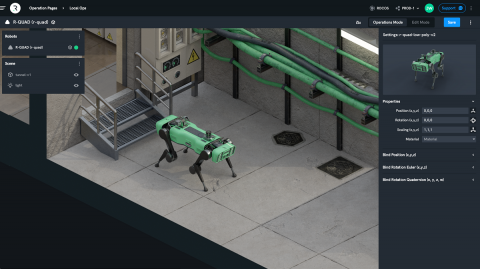
Rocos, Boston Dynamics partner to enhance existing capabilities of Spot robot
Robot operations software platform provider Rocos has partnered with Boston Dynamics to enhance the existing capabilities of Boston Dynamics’ Spot robot. Through the partnership, remote mission design and execution, as well as a teleoperation functionality, will be integrated into Spot.
Built to go where other robots cannot, Spot is a mobile, durable, and customizable robot. Equipped with the Rocos platform, the robot can now be managed from a remote location. Missions can be designed and edited on the fly, and remote teams can access sensor data collected during the mission. The robot can also be manually teleoperated to investigate issues, capture new data, or be redirected as required.
Weekend Roundup: May 15, 2020
This Week in the Unmanned Systems and Robotics World
To further commercialize its autonomous aerial vehicles (AAVs), EHang has entered into a strategic partnership with a Shenzhen-listed tourism platform company called LN Holdings. EHang will integrate its Urban Air Mobility (UAM) platforms into LN Holdings’ hotel/tourism businesses. (EHang)

Texas Electric Cooperatives, Exelon Clearsight partner to make UAS a part of utility inspections in Texas
Texas Electric Cooperatives Inc. (TEC) and Exelon Clearsight LLC have partnered to bring advanced UAS, robot, and software enabled inspections to utilities in Texas.
Under the agreement, TEC has exclusive rights to sell Exelon Clearsight's services to Electric Cooperatives, Generation & Transmission Cooperatives, and Municipal Authorities across the state of Texas.
“We are excited about partnering with Clearsight to provide unique value-added services to our members,” says Johnny Andrews, chief operating officer, TEC Manufacturing and Distribution Services.
PIT becomes first U.S. airport to deploy autonomous robotic cleaners equipped with ultraviolet lights
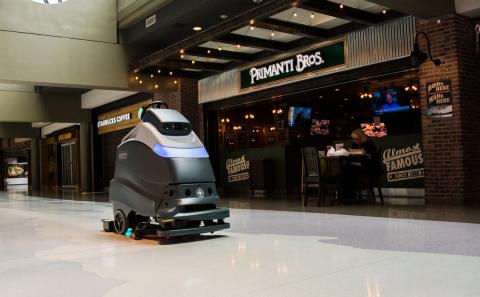
Pittsburgh International Airport (PIT) has become the first airport in the United States to deploy autonomous robotic cleaners equipped with ultraviolet (UV) lights that augment their traditional cleaning tools.
PIT and Pittsburgh-based Carnegie Robotics have partnered to deploy a pair of autonomous floor scrubbers that clean floors in an ultra-efficient manner.
According to Katherine Karolick, senior vice president of Information Technology for Pittsburgh International Airport, using UV is part of a strategic airport-wide approach to cleaning as airport officials look to incorporate UV disinfecting technology in other ways such as on handrails of escalators and moving walkways, elevator buttons and other high-touch areas.
Weekend Roundup: May 1, 2020
This Week in the Unmanned Systems and Robotics World
The Virginia Tech Transportation Institute (VTTI) is working with stakeholders across various communities to study challenging, dynamic scenarios involving automated driving systems. The collaborative team is also examining ways to facilitate communications between these systems and their supporting physical infrastructure. (Virginia Tech Daily)

MIT's 'Conduct-A-Bot' uses human muscle signals to pilot a robot's movement
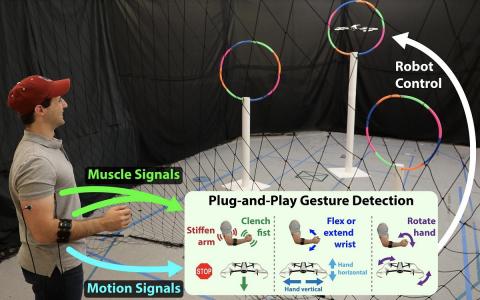
A team from MIT’s Computer Science and Artificial Intelligence Laboratory (CSAIL) has developed a system called “Conduct-A-Bot,” which pilots a robot’s movement using human muscle signals from wearable sensors.
The team says that Conduct-A-Bot could potentially be used for various scenarios, including navigating menus on electronic devices or supervising autonomous robots.
“We envision a world in which machines help people with cognitive and physical work, and to do so, they adapt to people rather than the other way around,” explains Daniela Rus, MIT professor and director of CSAIL, and co-author on a paper about the system.
Olds College to deploy fully autonomous DOT Power Platform on its Smart Farm
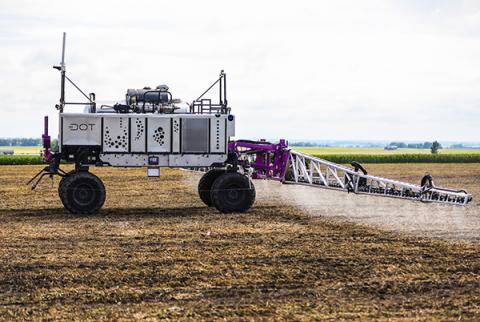
Olds College in Olds, Alberta, Canada has announced that it will be the only post-secondary institution in the world to deploy the fully autonomous DOT Power Platform as a teaching and research tool on the College’s Smart Farm.
Weekend Roundup: April 24, 2020
This Week in the Unmanned Systems and Robotics World
The University of North Florida College of Computing, Engineering and Construction has been awarded a grant to research the use of autonomous robotics for agriculture in Northeast Florida. The research grant will focus on using a multi-robot system to securely and efficiently collect agricultural information. (University of North Florida)

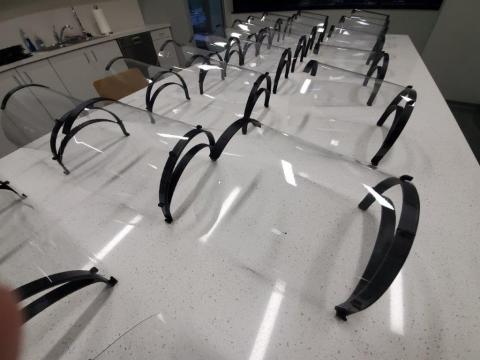
Robotic Research uses engineering expertise to develop reusable face shields for healthcare workers
The team of engineers at Robotic Research is using its engineering expertise to create reusable face shields for healthcare workers on the frontlines of the COVID-19 crisis.
The company says that it has created a unique design for reusable face shields and is providing them to healthcare teams in hospitals around the Greater Washington Metro area. They are currently being delivered to support teams at local hospitals in the Montgomery County area.