Robotics
Robotics

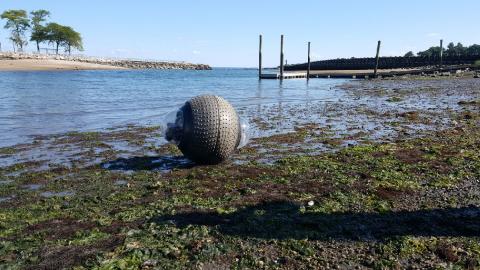
Aquiline Drones to power GuardBot's spherical and amphibious robotic vehicles via AD Cloud
Cloud and drone technologies company Aquiline Drones (AD) has announced that it will power the spherical and amphibious robotic vehicles from engineering company GuardBot using the AD Cloud (ADC).
Aquiline notes that ADC takes full advantage of its capacity, modularity and truly salient features for autonomous assignments, operations and quests, which makes it ideal for unmanned vehicle operations.
“In the coming months, ADC will undergo rigorous testing, hosting and management trials with GuardBot’s proprietary software application. ADC’s highly modular AI architecture is suitable for crucial customization of solutions typically not available in the open marketplace,” explains Barry Alexander, founder and CEO of Aquiline Drones and AD Cloud Services.
Starship Technologies' food delivery robots begin operating at Bowling Green State University
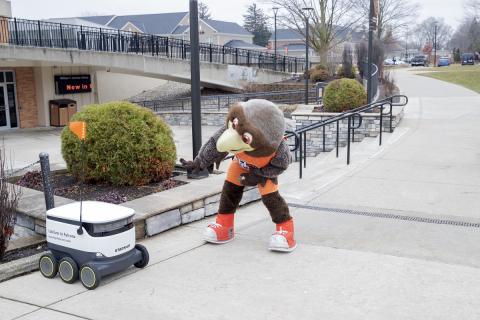
In collaboration with Starship Technologies, Bowling Green State University (BGSU) has become the first university in Ohio to offer a robot food delivery service on its campus.
A partnership between Starship Technologies and BGSU’s food-service provider, Chartwells Higher Education Dining Services, will result in Starship’s fleet of 30 autonomous, on-demand robots making deliveries from nine campus eateries including Starbucks, Dunkin Donuts and Panda Express.
Boston Dynamics, OTTO Motors showcase the role of robots in warehouse automation
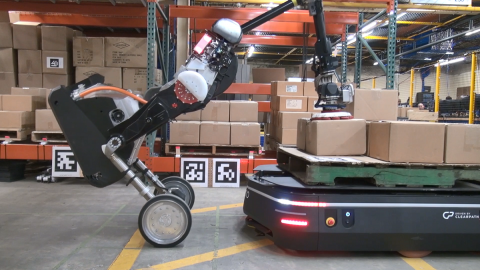
Boston Dynamics has collaborated with industrial autonomous mobile robots (AMRs) developer OTTO Motors to demonstrate the future of warehouse automation.
A video released on Tuesday, March 3, shows Handle, which is Boston Dynamics’s logistics robot, picking boxes and building pallets on top of OTTO AMRs in a distribution center testbed.
Last year, the Handle robot completed proof of concept trials with customers in their warehouses. Boston Dynamics and OTTO Motors are working together to further automate the logistics space.
U.S. Air Force orders 180-plus FLIR Systems Centaur UGVs
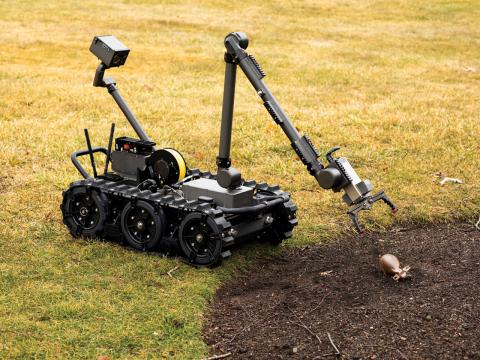
Through a $23 million contract sourced through the Dept. of Defense Man Transportable Robotic System Increment II (MTRS Inc II) program, the United States Air Force has ordered more than 180 of FLIR Systems’ Centaur UGVs, plus spares.
A remotely operated, medium-sized UGV system, Centaur provides a standoff capability to detect, confirm, identify, and dispose of hazards. The open-architected robot, which weighs approximately 160 pounds, is equipped with an advanced EO/IR camera suite, a manipulator arm that reaches more than six feet, and the ability to climb stairs. The robot's modular payloads can be used for CBRNE detection and other missions.
Shipments of the UGVs are expected to begin in the second quarter of 2020.
Swarming robots avoid crashes, jams using algorithm developed by Northwestern University researchers
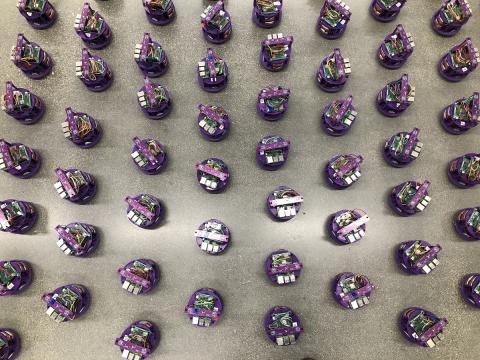
Northwestern University researchers have developed what they are calling the “first decentralized algorithm with a collision-free, deadlock-free guarantee.”
The algorithm could potentially one day help self-driving vehicles navigate one another safely and flawlessly without crashing or causing unnecessary traffic jams, but for now, it is helping robots avoid crashes and jams. The algorithm was tested in a simulation of 1,024 robots and on a swarm of 100 real robots in the laboratory. In less than a minute, the robots reliably, safely and efficiently converged to form a pre-determined shape, as you can see below:
MIT researchers enables soft robotic arm to understand its configuration in 3D space using "sensorized" skin
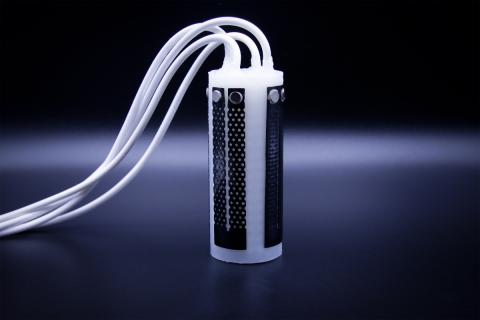
MIT has announced that for the first time, its researchers have leveraged just motion and position data from the “sensorized” skin of a soft robotic arm to enable it to understand its configuration in 3D space.
MIT notes that soft robots made from highly compliant materials—similar to those found in living organisms—are being championed as safer, and more adaptable, resilient, and bioinspired alternatives to traditional rigid robots. Giving these deformable robots autonomous control is considered a “monumental task,” though, because at any given moment, they can move in a virtually infinite number of directions, which makes it hard to train planning and control models that drive automation.
DARPA's OFFSET program deploys swarms of autonomous air and ground vehicles during third field experiment
DARPA’s OFFensive Swarm-Enabled Tactics (OFFSET) program deployed swarms of autonomous air and ground vehicles to demonstrate a raid in an urban area during the agency's third field experiment.
According to DARPA, OFFSET sees a day where swarms of up to 250 collaborative autonomous systems will provide important insights to small ground units in urban areas where limited sight lines and tight spaces can obscure hazards, as well as constrain mobility and communications.

AI robotics company Covariant launches from stealth
Artificial intelligence (AI) robotics company Covariant launched from stealth on Wednesday, Jan. 29, with the announcement that its AI has been deployed and is fully operational at customer facilities in several industries.
Covariant has spent the last two and a half years since being founded researching, developing, testing and deploying its AI, which has led to the development of the Covariant Brain. Covariant describes the Covariant Brain as “universal AI for robots that can be applied to any use case or customer environment.” Covariant robots are capable of quickly learning how to manipulate objects without being told what to do thanks to their ability to learn various general abilities.
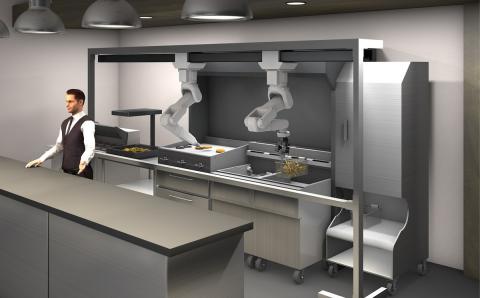
Miso Robotics unveils next generation robotic kitchen assistant platform
Miso Robotics has announced a prototype for its newest product, the Miso Robot on a Rail (ROAR), which the company describes as the “next generation of zero-footprint, cost-efficient robotic kitchen assistant solutions for evolving commercial kitchens.”
Thanks to feedback from top Quick Service Restaurants (QSRs), Miso Robotics has moved its robotic kitchen assistant Flippy to an upside-down rail. Designed to be installed under a standard kitchen hood, the newest generation of Flippy will be able to move along a line of kitchen equipment while staying out of the path of busy cooks.